Task Management System Admin Dashboard: A Comprehensive Design Guide
In the rapidly evolving landscape of digital product development, the efficiency of a project often hinges on the quality of its underlying interface. For developers, designers, and business owners alike, the Task Management System Admin Dashboard serves as a critical component in organizing workflows, tracking progress, and ensuring operational clarity. Whether you are building a custom web application, a robust Customer Relationship Management (CRM) system, or a specialized Human Resource Management System (HRMS), having a well-structured administrative panel is non-negotiable. This article explores the versatility, features, and practical applications of a professionally designed Task Management System Admin Dashboard created in Figma, offering insights into how it can streamline your development process.
The Core Purpose of an Admin Dashboard
At its heart, an admin dashboard is the command center for any web-based application. It is where administrators monitor data, manage users, and oversee system health. A dedicated Task Management System Admin Dashboard goes beyond simple data display; it provides a visual representation of complex information, making it digestible for decision-makers. The primary goal is to reduce cognitive load by presenting key metrics, pending tasks, and system alerts in a unified view.
For general consumers and small business owners, this translates to easier management of daily operations. For enterprise-level corporations, it means scalability and precision. When a dashboard is designed with user experience (UX) principles in mind, it transforms from a mere utility into a strategic asset that drives productivity. The ability to quickly grasp the status of a project or the performance of a sales team can be the difference between meeting a deadline and missing it.
Versatility Across Digital Platforms
One of the most significant advantages of a high-quality Task Management System Admin Dashboard template is its adaptability. While the name suggests a focus on task tracking, the underlying structure is robust enough to support a wide array of web applications. This flexibility makes it an ideal starting point for various projects:
- CMS and Content Portals: Editors can use the layout to manage articles, media libraries, and user permissions efficiently.
- SaaS Applications: Software-as-a-Service providers can customize the panels to display subscription metrics, usage analytics, and billing information.
- E-commerce Solutions: Store administrators can track inventory levels, order statuses, and customer support tickets within the same framework.
- Support and Social Portals: Community managers can moderate content, view user activity logs, and handle support requests seamlessly.
- Corporate and Personal Business Tools: From large-scale HRMS systems to personal productivity apps, the modular design accommodates diverse needs.
This cross-industry applicability ensures that the investment in a professional design file yields long-term value, regardless of the specific niche you are targeting.
Design Excellence and Technical Specifications
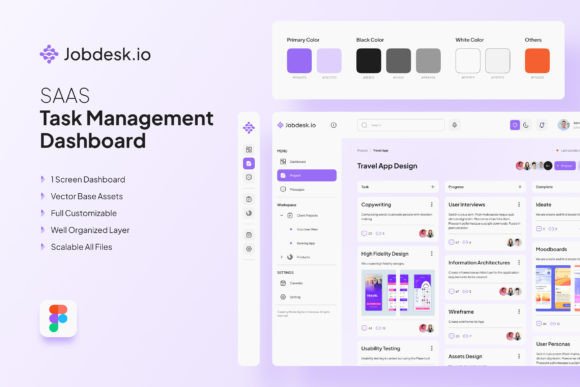
The foundation of a successful dashboard lies in its design execution. The Task Management System Admin Dashboard discussed here is crafted using industry-standard tools, specifically Figma, which allows for precise control over every element. The design adheres to modern standards, featuring a resolution of 1920 w × 1665 h px, ensuring it looks crisp on high-density displays. With a color mode set to RGB and a resolution of 150 dpi, the visual fidelity is maintained across different viewing environments.
A key characteristic of this template is its reliance on free fonts exclusively from Google Fonts. This choice not only reduces licensing costs but also ensures consistent rendering across all devices and operating systems. Furthermore, the file is fully layered and organized, meaning that every button, icon, and text block is distinct and editable. This level of organization is crucial for developers who need to extract assets quickly without sifting through a chaotic layer hierarchy.
The inclusion of vector shapes guarantees that the design remains retina-ready. As screen resolutions continue to increase, vector graphics ensure that icons and illustrations remain sharp and clear, avoiding the pixelation that often plagues raster-based images. Additionally, the clean and organized nature of the file makes it easy to change colors, shapes, and effects, allowing designers to align the dashboard with their brand identity effortlessly.
Key Components and Features
A comprehensive Task Management System Admin Dashboard includes several essential modules that cater to different administrative functions. Understanding these components helps in evaluating whether a template meets your specific project requirements.
- The Main Dashboard View: This is the landing page for administrators, typically featuring widgets for quick stats, recent activities, and priority alerts. It provides an immediate overview of the system's health.
- Calendar Module: Integrated scheduling tools allow users to visualize deadlines, meetings, and recurring tasks. A well-designed calendar view enhances time management capabilities significantly.
- Mail and Note Systems: Internal communication is vital for team collaboration. These sections provide interfaces for sending messages, leaving notes on specific tasks, and maintaining a record of correspondence.
- Customizable Assets: The ability to swap out images, icons, and color palettes ensures that the final product feels unique to the brand rather than generic.
It is important to note that while preview images may be included in marketing materials to demonstrate the potential of the design, the actual download files contain only the editable source elements. This distinction ensures that developers have a clean slate to work with, integrating their own assets as needed.
Real-World Scenarios and Applications
To truly appreciate the value of a Task Management System Admin Dashboard, consider how it applies to real-world situations. Imagine a startup launching a new SaaS platform. They need a backend to manage user subscriptions, track feature usage, and handle support tickets. Instead of designing a panel from scratch, they utilize this Figma template. Within hours, they can customize the color scheme to match their brand, replace placeholder text with real copy, and hand off the file to developers.
Consider another scenario: a mid-sized e-commerce retailer looking to upgrade their internal operations. Their current system is clunky and difficult to navigate. By implementing a fresh, responsive dashboard design, they can improve the speed at which staff processes orders and resolves customer issues. The calendar feature helps them plan seasonal promotions, while the mail module streamlines communication with suppliers.
For freelancers and creators managing multiple client projects, a personalized version of this dashboard acts as a central hub. They can track billable hours, monitor project milestones, and communicate with clients directly through the integrated note system. The flexibility of the design allows them to tailor the interface to their specific workflow, eliminating unnecessary clutter and focusing on what matters most.
Evaluating Suitability and Limitations
While the Task Management System Admin Dashboard offers numerous benefits, it is essential to approach its adoption with realistic expectations. The template provides a solid visual and structural foundation, but it is not a fully functional software solution. It requires integration with a backend framework, such as React, Vue, or Angular, to become a working application.
Prospective users should evaluate the following factors before committing to a design:
- Technical Skill Level: While the file is organized, modifying complex interactions or animations may require proficiency in Figma or similar design tools.
- Scalability Needs: Ensure that the grid system and component library can scale to accommodate future features without requiring a complete redesign.
- Brand Alignment: Although colors and assets are easily changeable, some deep customization might still be necessary to perfectly match corporate branding guidelines.
Furthermore, the limitation regarding preview images is a standard practice in design templates. Users must source their own imagery for the final deployment, which can be both a challenge and an opportunity to inject unique visual storytelling into the application.
Conclusion: Empowering Your Projects
In conclusion, a professionally crafted Task Management System Admin Dashboard is more than just a collection of screens; it is a strategic tool that empowers businesses to operate more efficiently. By leveraging a Figma-based template that is fully layered, retina-ready, and easily customizable, teams can accelerate their development cycles and deliver higher-quality products. Whether you are building a CRM, an e-commerce platform, or a personal productivity app, the right dashboard design sets the stage for success.
The emphasis on clean organization, free font usage, and flexible asset management ensures that this resource remains relevant across various industries and project scopes. As the digital world continues to demand faster and more intuitive interfaces, investing in a robust design foundation like this one is a prudent step for any creator, professional, or business owner ready to take their online presence to the next level.