Icons Work Together: Streamlining Visual Communication in Modern Design
In the fast-paced environment of digital creation, clarity is often the most valuable asset a designer can offer. When complex information needs to be conveyed instantly, visual shorthand becomes essential. This is where resources like Icons Work Together become critical components of a professional workflow. These are not merely decorative elements; they are functional tools designed to enhance user experience, guide navigation, and reinforce brand messaging without adding cognitive load. For professionals ranging from web developers to marketing strategists, integrating high-quality vector assets into a project requires a strategic approach that considers preparation, compatibility, and long-term usability.
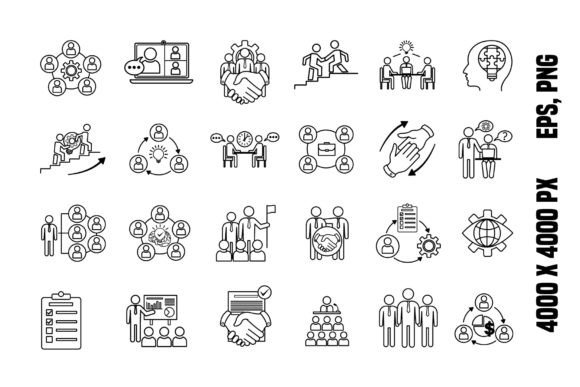
The specific collection known as Hi, welcome to the store Vector teamwork icons for web design represents a curated set of visual solutions tailored for collaborative themes. Whether you are building a corporate intranet, designing a SaaS landing page, or creating educational materials about team dynamics, these icons serve as the visual glue that holds your narrative together. Understanding how to leverage such assets effectively transforms a standard design process into a streamlined operation focused on efficiency and impact.
Understanding the Role of Vector Assets in Workflow Planning
Before any pixel is placed or code is written, successful projects begin with a clear understanding of the required assets. The decision to use a resource like Icons Work Together should happen during the initial planning phase, not as an afterthought when a layout feels empty. In this stage, designers and project managers must identify the key concepts that need visual representation. For a project centered on collaboration, leadership, or organizational structure, having a cohesive set of icons ready ensures that the visual language remains consistent from the outset.
Vector graphics, specifically those available in EPS and PNG formats within the ZIP file, offer distinct advantages during this planning stage. Unlike raster images, vectors are resolution-independent. This means that whether an icon is displayed on a small mobile screen or a massive billboard, the quality remains sharp. The 300 dpi resolution and 4000 x 4000 pixels dimensions provided in this package ensure that there is no compromise on fidelity, even when printing high-resolution marketing collateral. This technical specification allows teams to plan for multi-channel campaigns without worrying about image degradation.
Integrating these assets early also aids in the wireframing and prototyping process. When a designer knows exactly what visual elements will be used, they can create more accurate mockups. This reduces the likelihood of late-stage changes that often derail timelines. By selecting a pack like Icons Work Together at the beginning, the team establishes a visual baseline that guides color choices, spacing, and typography decisions throughout the entire project lifecycle.
Technical Integration and File Compatibility
Once the planning phase is complete, the focus shifts to execution. The technical specifications of the Icons Work Together package make it highly adaptable for various software environments and platforms. The inclusion of both EPS (Encapsulated PostScript) and PNG (Portable Network Graphics) files provides flexibility that is crucial for modern workflows. EPS files are the industry standard for print design and professional illustration software like Adobe Illustrator. They allow designers to edit paths, change colors, and adjust stroke weights to match specific brand guidelines perfectly.
Conversely, the transparent PNG files are optimized for immediate web deployment. Web developers can drop these directly into HTML structures or CSS backgrounds without needing additional processing. The transparency feature is particularly important for ensuring that icons blend seamlessly with diverse background colors and textures. This dual-format approach eliminates the need for time-consuming conversion processes, allowing teams to move quickly from concept to launch.
Compatibility extends beyond just file types. High-resolution assets like these interact smoothly with responsive design frameworks. Because the source files are large (4000 x 4000 pixels), they can be scaled down efficiently for different device breakpoints without losing detail. This ensures that a website looks crisp on a retina display just as well as it does on a standard laptop screen. Furthermore, the clean lines and simple geometry typical of teamwork icons ensure they remain legible even when scaled down to small sizes, which is vital for navigation bars and mobile interfaces.
Strategic Use Cases Across Industries
The versatility of Icons Work Together makes it applicable across a wide range of industries and use cases. For entrepreneurs and small business owners, these icons can define the "About Us" section of a website, visually articulating company values such as collaboration, communication, and shared goals. Instead of writing paragraphs of text explaining team dynamics, a row of well-chosen icons can convey the same message in seconds, improving user engagement and reducing bounce rates.
Marketers and content creators can utilize these assets to break up dense text in blog posts, white papers, and social media graphics. In an era of short attention spans, visual anchors help guide the reader through complex arguments. For example, when discussing the benefits of remote work or agile methodologies, icons representing virtual meetings, task management, and brainstorming sessions provide immediate context. This enhances the readability of the content and supports the overall SEO strategy by increasing the time users spend on the page.
For educators and instructional designers, these icons are invaluable for creating course materials and presentations. They can illustrate concepts related to group projects, peer reviews, and collaborative learning. The ability to customize the EPS files allows educators to align the visuals with their specific curriculum branding, ensuring a professional and cohesive look for all educational materials. Similarly, freelancers and publishers can use these assets to enhance pitch decks and proposals, demonstrating an attention to detail that impresses potential clients.
Optimizing Efficiency and Consistency
Maintaining consistency is one of the most challenging aspects of design, especially when working with multiple contributors or over extended periods. A dedicated icon pack like Hi, welcome to the store Vector teamwork icons for web design solves this problem by providing a unified style. Every icon shares the same line weight, curvature, and aesthetic approach. This uniformity prevents the disjointed look that occurs when mixing assets from different sources.
To maximize efficiency, teams should establish a centralized library for these assets. Once the ZIP file is downloaded and extracted, the files should be organized into a structured folder system within the project directory. This might include subfolders for "Web-Ready," "Print-Ready," and "Editable Source." By doing so, every team member—from the graphic designer to the front-end developer—knows exactly where to find the correct version of an asset. This organization reduces friction and prevents version control issues, ensuring that everyone is working with the latest, highest-quality files.
Furthermore, using a pre-designed set saves significant time on the creative process. Designing custom icons from scratch is labor-intensive and requires a high level of skill. By leveraging existing, high-quality vectors, teams can redirect their energy toward higher-level tasks such as user research, interaction design, and strategic planning. This shift in focus allows for a more holistic approach to product development, where visual assets support the broader business objectives rather than becoming a bottleneck.
Long-Term Value and Scalability
Investing in high-quality vector assets yields long-term value that extends far beyond a single project. As businesses grow and evolve, their visual identity must adapt. The scalability of EPS files ensures that the Icons Work Together collection can be modified to fit new brand directions. If a company decides to update its color palette, the vector format allows for instant recoloring without the need to recreate the artwork. This future-proofs the investment, making the assets a permanent part of the brand's toolkit.
Additionally, these icons can serve as the foundation for animation and motion graphics. With the rise of micro-interactions in web design, static icons are increasingly being brought to life. The clean paths found in vector files make them ideal candidates for SVG animation, allowing for subtle movements that enhance user engagement. Whether it is a button that pulses on hover or a loading sequence that depicts teamwork, the underlying vector data supports dynamic applications that static raster images cannot.
Ultimately, the decision to integrate Icons Work Together into a workflow is a decision to prioritize quality, consistency, and efficiency. It reflects a professional commitment to delivering polished, effective visual communication. From the initial planning stages to the final deployment and beyond, these assets play a pivotal role in shaping how information is perceived and understood. By embracing these tools, professionals across all sectors can elevate their work, streamline their processes, and achieve better outcomes for their audiences and stakeholders.