Home Care Bifold Brochure: A Strategic Asset for Professional Communication
In the competitive landscape of healthcare services, first impressions are often formed before a single word is spoken. For agencies, independent caregivers, and medical service providers, the physical collateral used to introduce their brand plays a pivotal role in establishing trust and credibility. The Home Care Bifold Brochure serves as a critical touchpoint in this journey, bridging the gap between digital marketing efforts and tangible client interaction. This template is not merely a design file; it is a structured communication tool designed to convey complex care information in an accessible, visually appealing format.
Whether you are a small business owner launching a new senior care initiative or a marketer refining an existing brand identity, understanding how to leverage this specific asset within your broader workflow is essential. It fits into the planning, execution, and distribution phases of your marketing strategy, offering a customizable foundation that ensures consistency across all printed materials.
The Role of Physical Collateral in Modern Workflows
Digital channels dominate modern advertising, yet the tactile nature of a well-designed brochure remains unmatched in certain contexts. When families are searching for home care solutions, they are often dealing with high-stress situations involving aging parents or loved ones recovering from illness. In these moments, a professional, easy-to-read document can provide a sense of stability and competence that a website alone may struggle to convey.
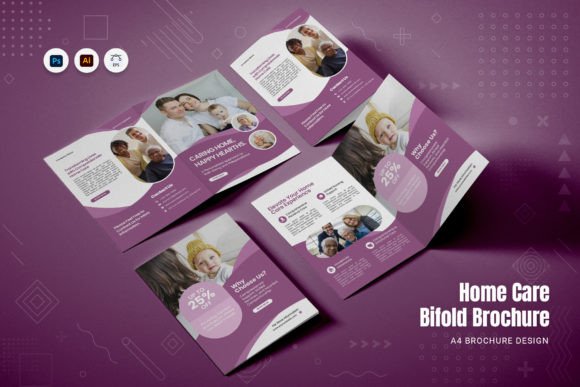
The Home Care Bifold Brochure is engineered to function effectively within this emotional and practical context. Its bifold structure allows for a logical flow of information, guiding the reader through an introduction, service details, testimonials, and contact information without overwhelming them. This format is particularly effective for handouts at community health fairs, consultations in waiting rooms, or direct mail campaigns targeting specific neighborhoods.
Integrating this brochure into your workflow requires viewing it as part of a larger ecosystem. It should complement your website content, social media presence, and verbal sales pitches. Consistency in messaging and visual identity across these platforms reinforces brand authority. When a potential client reads about your compassionate approach on your website and then holds a brochure that reflects the same tone and style, the message is reinforced, increasing the likelihood of conversion.
Evaluating Template Specifications for Print Readiness
Before diving into customization, it is crucial to understand the technical specifications that make this template a viable option for professional printing. The template is built on an A4 paper size standard, which is universally recognized and cost-effective for most print runs. More importantly, it is configured in CMYK color mode at 300DPI. These are non-negotiable standards for high-quality offset and digital printing. Using RGB files or lower resolutions often results in washed-out colors and pixelated images, which can undermine the professionalism of your brand.
The inclusion of bleed areas is another critical feature. Bleed refers to the extra space around the edges of the design that extends beyond the trim line. This ensures that when the brochure is cut to its final size, there are no unsightly white borders caused by slight shifts during the cutting process. A fully print-ready file saves time and prevents costly reprints, allowing you to focus on content rather than troubleshooting technical errors.
Furthermore, the template utilizes free fonts. This is a significant advantage for scalability and budget management. Many designers rely on premium licensed typefaces that require expensive subscriptions or per-project fees. By using free fonts that are included with the package, you ensure that anyone on your team can open and edit the file without compatibility issues or additional licensing costs. This democratizes the editing process, allowing marketing managers, administrative staff, or external freelancers to update content seamlessly.
Customization and Content Strategy
The true value of the Home Care Bifold Brochure lies in its flexibility. The template is fully layered and well-organized, meaning every element—from text boxes to image placeholders—is distinct and easily editable. This organization is vital for efficiency. When you need to update a phone number, replace a photo of a caregiver, or adjust a service description, you do not have to navigate a chaotic mess of merged layers. You can locate the specific element instantly, make the change, and save the file with confidence.
Effective customization goes beyond simple text replacement. It involves aligning the content with your specific value proposition. For a home care agency, this might mean highlighting specialized services like dementia care, post-surgical support, or companion services. The layout provides clean sections where these distinctions can be made clearly. Use paragraph styles to maintain consistent typography throughout the document. If you change the font size for headings in one section, applying the style globally ensures the entire brochure remains uniform.
Image selection is equally important. The template includes image placeholders, but the quality of the photos you insert will define the emotional resonance of the piece. Avoid generic stock photography that feels disconnected from reality. Instead, use authentic images of your actual staff, facilities, or happy clients (with permission). This authenticity builds trust. When a family sees real people who will be caring for their loved ones, the barrier to engagement lowers significantly.
Integration with Design Software and Teams
Workflow efficiency is enhanced by the compatibility of this template with industry-standard software. The package includes both Adobe Illustrator (.ai) and Adobe InDesign (.indd) files. This dual-format availability offers flexibility based on your team's expertise and the complexity of the project.
Adobe Illustrator is ideal for graphic-heavy edits, logo adjustments, and vector-based modifications. If your primary need is to tweak the graphical elements or create variations for different campaigns, the .ai file provides robust control over shapes and paths. Conversely, Adobe InDesign is the superior choice for text-heavy documents and multi-page layouts. If your brochure contains extensive service descriptions, detailed pricing tables, or multiple pages of testimonials, the .indd file offers better text handling capabilities, including advanced paragraph and character styles.
For teams working collaboratively, having both formats ensures that no bottleneck occurs. A graphic designer might handle the initial branding setup in Illustrator, while a content manager updates the text and imagery in InDesign. The "Readme .txt" file included in the package serves as a quick reference guide, outlining the folder structure and any specific instructions for opening the files. This documentation reduces the learning curve for new team members and minimizes the risk of accidental damage to the master file.
Implementation Strategies and Distribution Channels
Once the Home Care Bifold Brochure is customized and proofread, the focus shifts to distribution. The physical nature of the brochure dictates specific strategies for maximum impact. Consider integrating the brochure into your client onboarding process. When a new family signs up for services, providing them with a physical copy of the brochure serves as a welcome kit item that outlines what to expect, reinforcing the agreement and setting clear boundaries.
Another effective use case is community outreach. Local libraries, senior centers, and hospitals often have bulletin boards or resource rooms where informational materials are displayed. Having a stack of professionally printed brochures ready to distribute in these locations positions your agency as a local resource. Unlike digital ads that can be scrolled past in seconds, a brochure left on a table invites a slower, more deliberate engagement.
From a long-term perspective, maintaining a library of updated templates is a smart business practice. As your services evolve, you can quickly generate new versions of the brochure without starting from scratch. The organized layers and modular design allow for rapid iteration. You might create seasonal variations, special offer editions, or targeted versions for specific demographics, such as veterans or young adults needing care. The ability to produce these variations efficiently keeps your marketing agile and responsive to market needs.
Quality Control and Final Review
Before sending the file to print, a rigorous quality control process is necessary. Even with a well-organized template, human error can occur during the editing phase. Check for spelling errors, verify that all contact information is current, and ensure that all images are high-resolution. Since the template is set to 300DPI, inserting low-resolution web images will degrade the overall quality. Always check the color profiles to ensure they match the CMYK settings of the printer.
It is also advisable to print a hard copy proof before committing to a large run. Viewing the design on screen can sometimes mask alignment issues or color discrepancies that become apparent on paper. This step allows you to catch any formatting glitches that might have occurred during the editing process. Once the proof is approved, the file is ready for production, ensuring a smooth transition from digital design to physical product.
The Home Care Bifold Brochure represents more than just a printable document; it is a strategic component of a comprehensive marketing and communication plan. By leveraging its technical strengths, customizing it with authentic content, and distributing it through targeted channels, businesses can enhance their professional image and connect more effectively with the communities they serve. Whether used for education, marketing, or internal documentation, this template provides a reliable foundation for clear, impactful communication.